
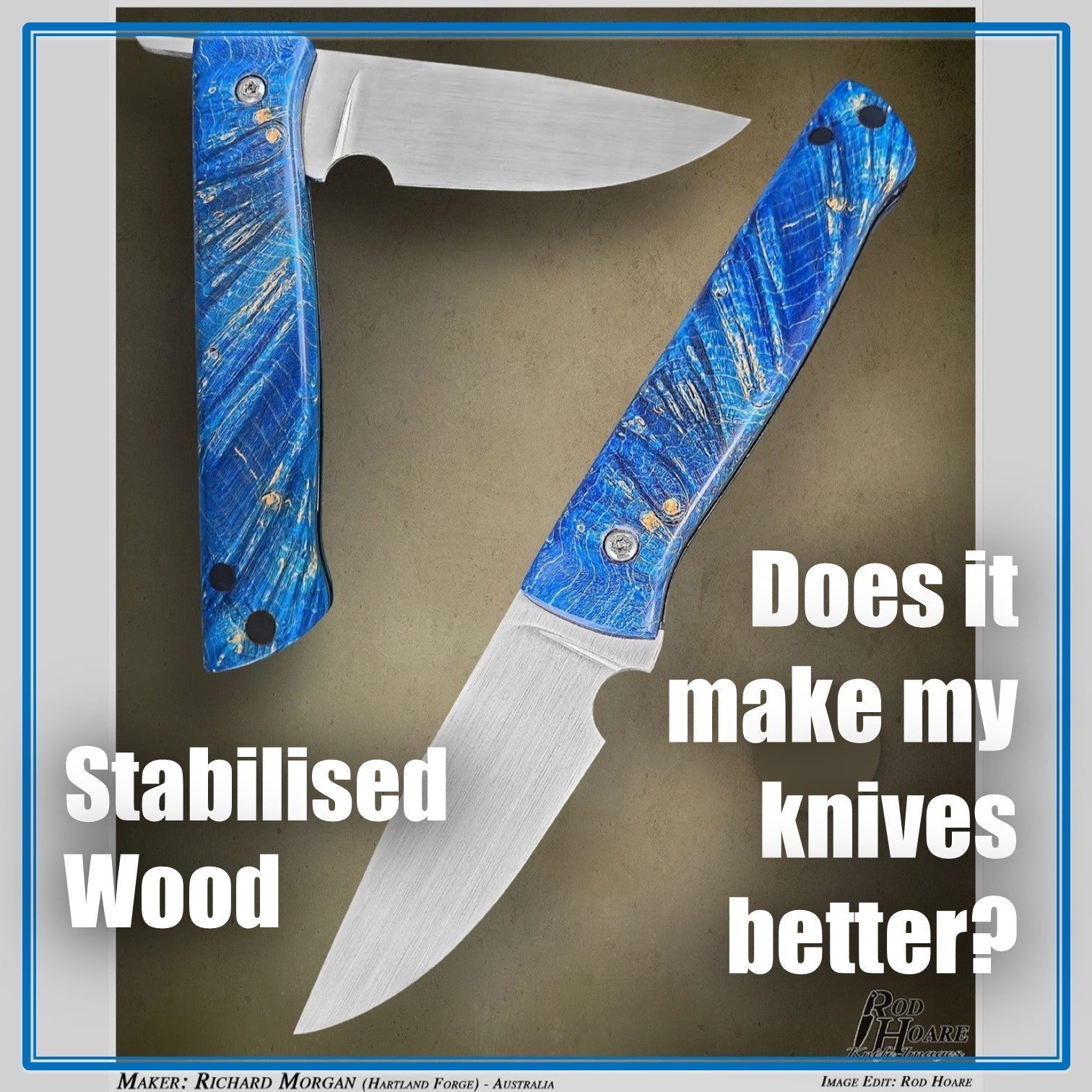
Stabilised wood, what is it? And will it make my knives better?
Many people often ask,
- what is stabilized wood?
- Does wood need to be stabilized?
- How do you stabilize wood?
- How much does stabilising wood help?
- How do I know if a piece of wood is stabilized?
All super valid and important question. Due to stabilising being rather uncommon outside of the knifemaking industry hopefully we can help answer some of those questions and more.
What is stabilized wood?
Stabilised wood is a process of soaking timber in stabilizing resin and subjecting it to a series of vacuum and pressure cycles to pull the resin throughout the timber and push out all the air. Thus, making a denser, tougher, stronger wood product that’s more resistant to water, warping and chipping which can take a much higher polish then its natural version. During the stabilising process you can also choose to dye the timber with certain dyes.

Knife makers have a particular affinity for stabilized wood. Natural wood's tendency to move, even slightly, can cause misalignments, the peeling of scales from a knife's tang, or the formation of tiny gaps. Stabilizing wood also makes it possible to use softer varieties like spalted maple and burls for knife handles. While these woods are too soft in their natural state, easily suffering from gouges and marks, stabilization enhances their durability, making these attractive woods viable for use in crafting knife handles.
How do I know if a piece of wood is stabilized?
This question is asked a lot. The short answer is unless you bought it or were given it from a source you trust its hard to say for certain if its been stabilised and if it has been, the quality of that stabilisation.
In all likelihood if it’s a random bit of timber you’ve picked up from a timber dealer its not going to be stabilised, mostly because its an uncommon and expensive process and if it was you would be told as it increases that value of the piece.

There are some signs that a wood has been stabilised though.
- If unsanded can be covered in a hardened resin that’s rather dark. There can often be bits of tin foil stuck on from the process.
- When sanded will give off a whiteish dust from the added resin in the wood.
- Will often smell a little sweet and plasticy regardless of the species.
Does my wood Need to be stabilized?
It depends on what wood it is and what you’re using it for. We sell a wide variety of timbers here, for use as a knife handles. Some need stabilisation others do not. Generally, we will mention if it would benefit on the product page if you’re buying from us but if it’s a piece that we don’t sell there are some questions you have to ask yourself.
- Is this timber overly airy and light?
- Is this timber spalted or punky?
- Can I mark this timber with my fingernail?
If the answer to any of these questions is yes, then it’s usually recommended that stabilisation is used if you’re looking to use it as a knife handle.
If you’re unsure, Greenberg woods in the states has an excellent article on a wide range of common timbers that do and don’t need stabilizing. Wood Identification and info.
How do you stabilize wood?
The short answer to this question is I don’t. I pay experts to do it for me who do it perfectly for me. The process is rather labour intensive and complicated with every wood needing slightly different process’ depending on how oily and dense it is before stabilising.
However, if you want to give it a crack, we do sell stabilising resin here.
Some people who do stabilising locally include.
(if you know anyone in Australia that needs to be added to this list, please let me know)
How much does it help?
The answer to this question depends on the wood species, its use, and the desired look.
Lighter woods like buckeye burl, light maple burl, Redwood burl, Cottonwood, and poplar can double or triple in weight after stabilization, becoming significantly harder and more resistant to scuffs.
Medium-density woods such as Hard maple, koa, Amboyna, Walnut, and bog oak typically see a 60%-80% weight increase, with durability approaching that of exotic woods like blackwood or cocobolo.
Denser woods like ebony, rosewood, and Ironwood gain little from stabilization. While stabilization can improve stability and resistance to cracking in woods like Ebony or bubinga, the benefits are generally modest, so it’s a decision that depends on specific needs.
Common problems that happen during stabilisation
-
My wood is cracked!
This usually happens if the wood was too wet. Ensure that the moisture level is as low as possible by drying the timber slowly to minimize the risk of cracking and warping. -
My wood didn’t gain any weight after stabilizing!
This might be because the wood wasn’t soaked and kept under pressure long enough. It's recommended to keep the wood under pressure until bubbles stop forming, longer is better.
-
There are still large gaps in my wood!
Stabilization won't fill voids completely; it only fills the pores of the wood. Large gaps need to be filled with super glue after stabilization, or with other resins and dyes if the voids are substantial. -
My wood still feels like wood and absorbs water!
Stabilization doesn’t turn wood into a plastic resin block. It remains timber and should be treated as such. The natural fibers will always retain their original properties, even after soaking in resin.
Stabilizing wood is a complex topic and lengthy process, largely because each timber species is unique, with its own characteristics and requirements. Some woods need stabilization to become suitable for knife handles, while for others, it may be unnecessary or even impractical due to their natural oils. The key is to work with materials you know well and that will help you create the high-quality products you aim for.


