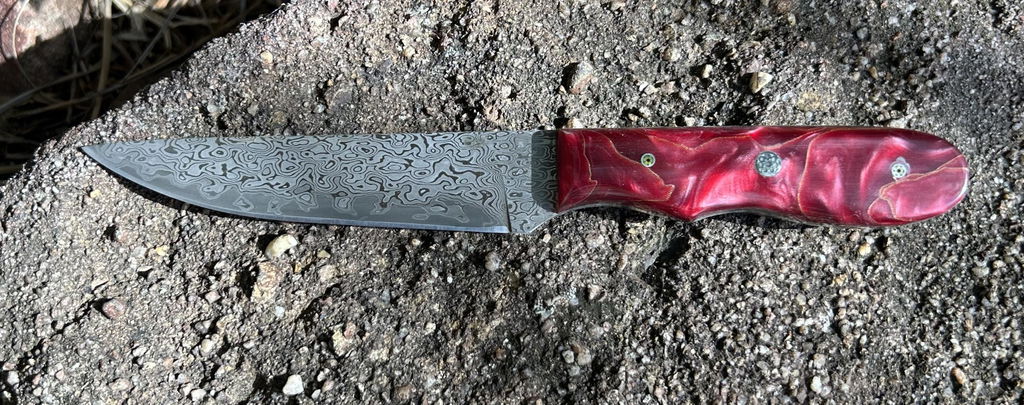

Overview
G10, A material we all know about in the knifemaking world. Its seen on almost every knife either as a full handle or just a tiny black line in the form of a liner or spacer. But how many of us really know what this stuff is? To be honest, for the longest time I had no idea. I just said "oh yeah G10... It's like a glass fiber stuff" but I had no idea really what it was, how it was made or how best to use it. So, I've dug into it to find out.

The short answer of what is G10?
G10 is a fiberglass laminate composite. It's made by layering woven fiberglass cloth with an epoxy resin binder and under intense pressure and heat its squished together into the perfect sheets of G10 we know and love. It's a super dense, rigid material known for its exceptional strength to weight ratio, electrical insulation, resistance to moisture, chemicals and physical impact.
It was discovered in the mid-20th century and for the early years of the technological revolution it underpinned almost every single circuit board in every computer. It's not broadly irrelevant in PCB boards but has found a home in knifemaking and tactical equipment due to how tough the stuff is.
The rest of this article goes deeper into the history, how its made, what we use it for and all the other important info you need to use this material.
Table of contents
- What is G10 & How is it made?
- The history of G10
-
Using & Finishing G10 in knifemaking
- Selection
- Cutting & Shaping
- Fitting
- Grinding, Contouring & Texturing
- Finishing
-
How to stay safe using G10
- Keeping the dust down
- PPE needed
1. What is G10 & How is it made?
As mentioned above G10 is a fiberglass laminate composite made under high pressure and heat. Widley regarded as one of the best materials for knife handles just by the fact that it is so incredibly durable and stable. The issue with materials like wood is they are often considerably softer and less wearing then G10 will ever be and so its gained its name mostly in the working knife category. If you want a handle to just work and not ever have to worry about it you pick G10.
G10 goes through 5 core steps to become the sheets you know.
1. Material preparation & Resin Impregnation
Fiberglass cloth is produced by weaving glass fabric rolls, these are unwound and pressed through the epoxy resin. The resin is required to completely penetrate through the individual glass filaments completely removing all air inside the material. The right viscosity of resin is needed to ensure that not too much or little of the resin is held within the sheets

2. Pre-Drying and Pre-Preg sheet Formation
Once the sheets are impregnated the resin filled cloth sheets go through a heating process to partially cure them, this creates what's known as "Pre Preg" Sheets which are semi cured sheets that are sticky but not fully hardened. These can be handled and cut to the right size and stacked without them sticking to each other permanently.
Its vital that during this time the temperature does not exceed 180°C and they're only heated for up to 5 minutes. Any longer or hotter would set the resin off fully.
3. Layup & Stacking
Multiple layers of the Pre-Preg sheets are stacked on top of each other to achieve the thickness that the factory is looking to make. For us knifemakers that's anywhere from 0.5mm to 10mm usually so the factory knows exactly how many sheets they need to get each thickness consistently every time.
4. Hot Pressing & Consolidation
The sheets now stacked are placed in a giant hot hydraulic press that uses the heat and pressure to finish the curing process. Every factory, resin ect is a little different but the typical specs are as follows
- Temperature: 150°C to 180°C (300°F to 355°F)
- Pressure: 1000-2000 psi (7-14 MPa)
- Time: 60-90 minutes depending on thickness
During hot pressing, heat activates the curing agents to fully cross-link the epoxy resin molecules, while the applied pressure consolidates the layers, eliminates voids, and ensures tight contact between plies. As excess resin is expelled from the edges, the material reaches its final density and thickness.
5. Post-Curing & Quality Control
Once all heating and pressing cycles are complete, they are released from their pressure and let to sit in post curing ovens for a couple hours to ensure that all the resin is fully cured. This process finishes off all the polymerization reactions and ensures the maximum strength, rigidity, thermal resistance and dimensional stability for the material.

Sheets are routinely inspected for defects like uneven thickness, how flexible they are, water absorption rates and a list of other checks to make sure they're compliant for the application.
This process is almost exactly the same as how Micarta is made. Just the resins and the base materials are different. Instead of glass fiber various fabrics are used.
2. The History of G10
G10 traces its origins to the mid-20th century, emerging from broader advances in industrial composite materials during and after World War II. The war effort drove enormous innovation in synthetic materials, as engineers sought lightweight, durable alternatives to metal for aircraft, electronics, and military equipment. That wartime urgency laid the groundwork for a generation of composite laminates that would go on to shape the modern world.
The development of G10 falls under the NEMA (National Electrical Manufacturers Association) grading system for laminate materials, established to standardise industrial composites in the United States. G10 was classified as a specific grade within this system, denoting a particular combination of woven fibreglass cloth and epoxy resin. It represented a meaningful step forward from earlier paper or canvas-based laminates such as Bakelite, offering superior mechanical strength and dimensional stability.
Through the 1950s and 1960s, G10 became the backbone of the emerging electronics industry. As printed circuit boards became essential to computing, telecommunications, and consumer electronics, G10's reliable insulation and dimensional stability made it the substrate of choice for manufacturers around the world.
FR4, a flame-retardant derivative of G10, eventually became the dominant PCB standard from the 1970s onward, largely superseding G10 in electronics applications. Rather than fading into obscurity, however, G10 found a strong second life in tactical and outdoor industries. By the 1980s and 1990s, knifemakers and firearms manufacturers had widely adopted it for handles and grips, cementing the material's reputation well beyond the electronics world.
Today G10 occupies a firm place in the craftsman's material palette, respected both for its heritage in precision manufacturing and its practical excellence in the field.
3. Using & Finishing G10 In Knifemaking
Selecting G10 G10 comes in sheets typically 3-10mm thick, in a wide range of colours and layered patterns that become visually striking once shaped, revealing the internal laminate structure. Choose thickness based on your tang design: full tang knives use scales on each side, hidden tang designs use a single drilled block. Buy slightly oversized to allow for trimming and correction during fitting.
Cutting and Shaping A wet tile saw is the recommended cutting method, as it continuously floods the cutting area with water, suppressing the fine fibreglass dust G10 generates and producing clean, precise cuts. Bandsaw, angle grinders, and belt grinders are all viable alternatives. Regardless of method, respiratory and eye protection are absolutely essential. The fibreglass particles produced by dry cutting are extremely fine and hazardous with repeated unprotected exposure. Even when using a wet saw, a basic dust mask remains sensible practice. G10 is highly abrasive, so carbide-tipped tooling is strongly recommended throughout to avoid quickly dulling standard steel tools.
Fitting the Scales Rough-cut scales are matched to the tang, marked, and drilled slightly undersized before being carefully fitted with pins, bolts, or corby bolts. A quality two-part epoxy applied between the scale and tang before pinning creates a bond that is effectively permanent, eliminating any possibility of movement or moisture ingress over time.
Grinding, Contouring, and Texturing Shape scales flush to the tang starting at 60-80 grit, then work progressively through 120, 220, and up to 400 grit to refine the profile and remove scratches. G10 takes texture exceptionally well: stippling, jimping, or aggressive patterns can be added with a Dremel, checkering file, or coarse grinding wheel, providing excellent grip even in wet or difficult conditions. If adding texture, keep finish sanding to smooth areas only and avoid sanding textured zones flat.
Finishing Hand sand from 220 through 320, 400, 600, and 800 grit, ensuring each stage fully removes the scratches left by the previous one. From 800 grit upward, wet sanding with water or mineral oil reduces paper clogging and produces a noticeably cleaner surface. Taking G10 to 1200 or even 2000 grit yields a near-polished, almost glassy finish that highlights layered colour patterns beautifully. A light coat of Renaissance Wax or similar microcrystalline wax adds a subtle lustre without meaningfully affecting grip. Unlike wood, G10 requires no sealing or ongoing maintenance, making it one of the most practical handle materials for a working knife.
Before considering the handle complete, inspect it closely under good lighting for remaining scratches, uneven transitions, or inconsistencies where the scales meet the tang. A well-finished handle should feel completely seamless, with no sharp edges, no visible epoxy squeeze-out, and consistent surface quality across the entire grip.
4. How To Stay Safe While using G10
The fibreglass content that gives G10 its strength is also what makes it hazardous when cut, ground, or sanded. Taking the following precautions seriously is essential for anyone working with it regularly.
Respiratory Protection The greatest risk is inhaling fine fibreglass particles, which are invisible to the naked eye and can cause long-term respiratory harm with repeated exposure. A basic dust mask is insufficient. A properly fitted P2/N95 respirator is the minimum, with P100 recommended for heavy grinding. This applies even when using a wet tile saw, which suppresses but does not eliminate airborne particles.
Eye and Skin Protection Wraparound safety glasses or goggles should be worn at all times, as fibreglass fragments travel unpredictably during grinding. For skin, nitrile gloves are advisable during sanding and finishing. After any session, wash exposed skin with cold water: hot water opens the pores and can drive particles deeper rather than rinsing them away.
Ventilation and Dust Extraction Work in a well-ventilated space and connect a dust extractor or shop vacuum to grinding and sanding equipment where possible to capture particles at the source. Fibreglass dust should be disposed of carefully and kept separate from general workshop waste.
Clothing Wear long sleeves, avoid touching your face during work, and wash contaminated clothing separately to prevent fibreglass particles transferring to other garments.